
1. What Is the Sound-and-Image Approach?
When learning a new English word, children are often encouraged to remember its spelling and Chinese meaning. But remembering a translation does not always mean understanding or being able to use the word.
The sound-and-image approach offers another way to build vocabulary.
The central idea is to connect the sound of a word with a mental image, an action or a familiar situation. Instead of relying only on a written word and its translation, children begin to associate what they hear with what they can imagine and understand.
Sound becomes a cue for meaning, while an image can help bring the word back to mind.
For example:
- Hear apple → picture an apple → understand what it refers to.
- See an apple → recall the word apple → say it aloud.
The relationship works in both directions:
Sound ⇄ Image ⇄ Meaning
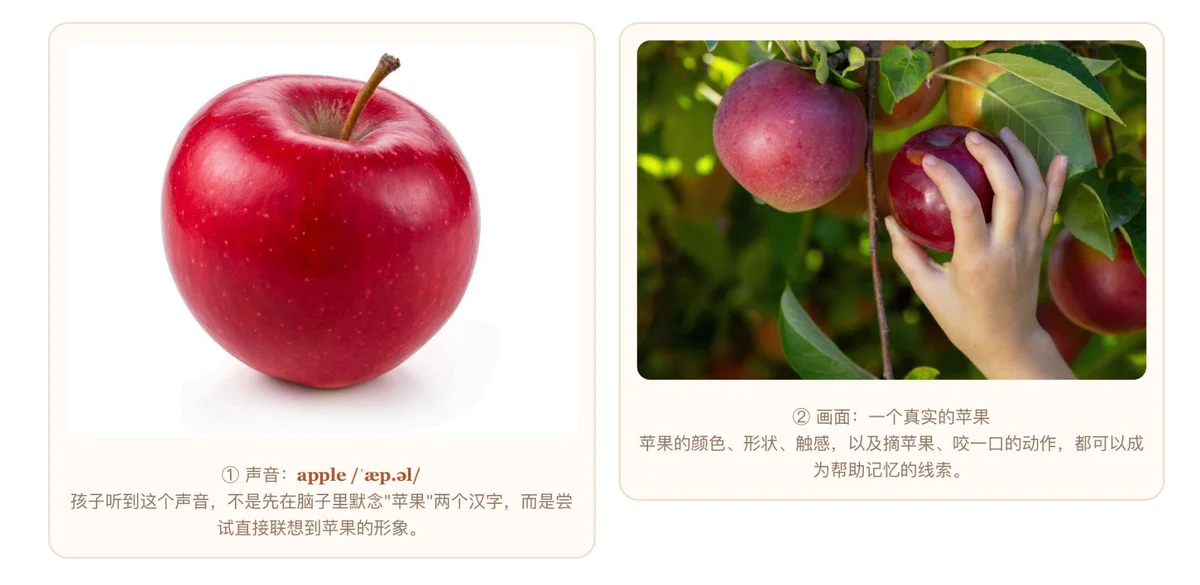
The aim is not to help children memorise more pictures. It is to help them build a more direct connection between the sound of an English word and its meaning.
2. Why Might This Approach Help?
There are several learning principles behind this approach.
Dual Coding
Verbal information and visual imagery can create different but connected representations in memory. Combining words with meaningful images may give learners more than one way to remember information.
Learning in Context
Words become easier to understand when they are connected to actions, stories and familiar situations. Children can begin to see not only what a word means, but also how it is used.
Retrieval Practice
Remembering a word without looking at the answer is an important part of learning. Children can listen and recall an image, or look at an image and try to say the word. This active effort to retrieve information helps strengthen memory.
It is worth remembering that the sound-and-image approach is a teaching idea, not a scientifically established method that works best for every word or every learner. Pictures are not necessarily better simply because there are more of them. What matters is making accurate, meaningful connections and strengthening them through practice.
3. Different Words Need Different Anchors
Not every English word can be remembered through a single static picture. Different kinds of words call for different kinds of connections.
Concrete Nouns — dog /dɒɡ/
When children hear dog, they can picture a dog. Real photographs of different dogs can help them connect the sound with the concept, rather than memorising just one particular picture.
Action Words — jump /dʒʌmp/
Instead of remembering only the Chinese translation, children can watch someone jump or try the action themselves while hearing the word. The movement becomes another memory cue.

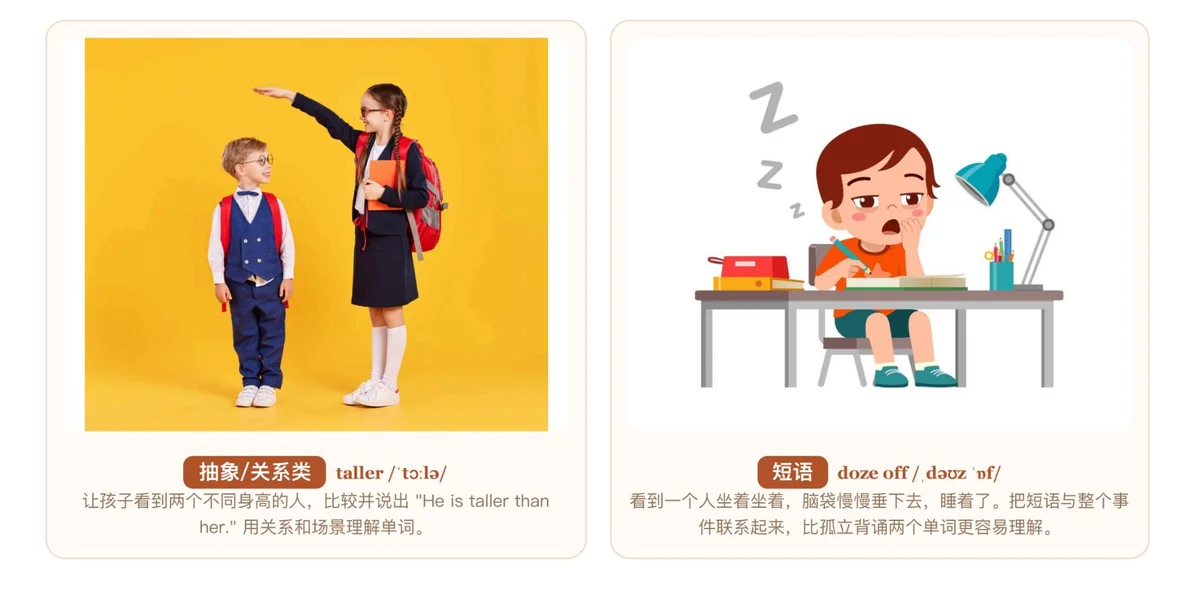
Comparative Words — taller /ˈtɔːlə/
Show two people of different heights. Let children compare them and say:
He is taller than her.
Here, the meaning becomes clear through a visual comparison and a meaningful relationship.
Phrases — doze off /ˌdəʊz ˈɒf/
Imagine someone sitting quietly, their head gradually nodding as they begin to fall asleep.
Connecting the whole phrase with this familiar event can be more meaningful than memorising the two words separately.
4. From Remembering an Image to Using a Word
There is an important step beyond recognising a word in a picture.
If a child looks at a picture of an apple and says apple, the child may simply have learnt a picture-word association. This does not necessarily mean the word can be understood and used in a real conversation.
A simple four-step practice can help:
- Listen — Hear the word without immediately looking at its translation.
- Imagine — Bring to mind a picture, action or situation connected with its meaning.
- Retrieve — Cover the word or picture and try to recall it independently.
- Use — Put the word into a sentence, a story or a real-life situation.
The aim is to build a richer network of connections:
Sound ⇄ Meaning ⇄ Image ⇄ Action ⇄ Context ⇄ Use
A word gradually becomes more than something a child can recognise. It becomes something they can understand and use.
5. What Does This Look Like in Reading?
Reading stories offers many opportunities to build these connections naturally.
For example, when a child comes across the word glum in Fantastic Mr Fox, simply memorising its Chinese translation may not be enough.
But imagine the character looking downcast, with a sad expression. The child can notice the character's appearance, think about what has happened in the story, and try to describe the feeling in English.
The word now has a face, an emotion and a reason behind it.
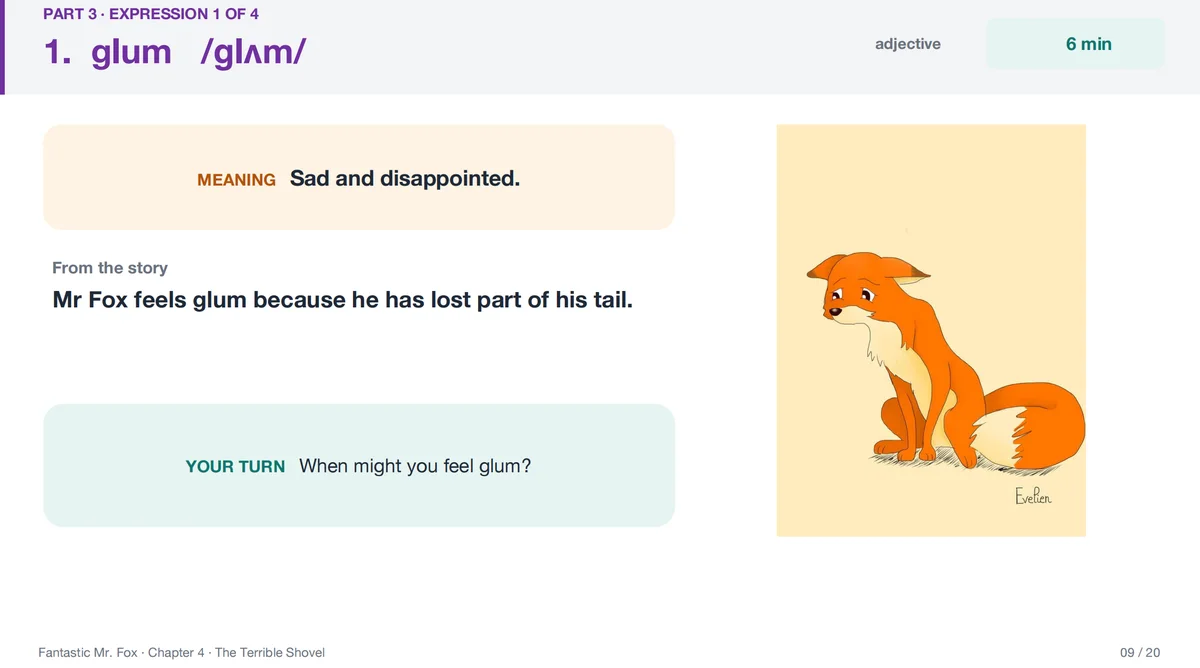
It is no longer just a vocabulary item on a list. It belongs to a story the child understands.
Of course, not every word has an obvious picture or action.
Words such as although, unless and despite are better understood through sentences, logical relationships and context. Trying to find a picture for every word is neither necessary nor helpful.
A Final Thought
The sound-and-image approach is not about replacing vocabulary learning with pictures.
It is about using sound, images and meaningful situations to help children connect words with their meanings. Through understanding, retrieval and use, these connections can gradually become part of their language ability.
The goal is not simply to remember a word, but to make it meaningful enough to use.
← Back to the Journal